So You Want to Buy a Home…

So you want to buy a home…. now what?

Mortgage Pre-Approval

This should be the first step when looking at buying a home. By doing this, you will know how much you can afford. The process involves filling out an application, having your credit bureau pulled, and going through your income and down payment documents. Mortgage Brokers don’t cost you anything, but we will talk to you about potential costs you’ll incur when buying and make sure that you are well prepared for the next step!.

Finding a Realtor

Once you are pre-approved, it is now time to find a Real Estate Agent. Your Agent will help you find a home based on what your needs, wants and budget are.

Search Party!

Your Agent will help you compile a list of homes that you wish to view in person. They will contact the sellers to set up the viewings. Sometime when you find a house you love, you may want to view the home more than once. Your Agent will walk you through the home and answer any questions you may have.


Offer Preparation and Negotiating

You have found the one!! Now you need to make an offer on the home. Your agent will guide you with the proper conditions to add to the offer (ie: home inspection, conditions of financing, etc) to guarantee you have taken all the proper steps to ensure a thorough investigation of the property. The seller may come back with a counteroffer. Your agent will help guide you through the entire negotiating process.

Offer Acceptance

They have accepted your offer! You and your home buying team (Realtor, Mortgage Broker, Home Inspector, etc) have 7-12 days to satisfy the aforementioned conditions that were outlined in the offer.


Mortgage Approval and Removal of Conditions

Once your offer is accepted, it will be sent over to me, by your Real Estate agent, to finalize the details of your mortgage and obtain a full, unconditional approval. The lender will require a list of documentation in order to close the mortgage. Common docs include (but not limited to): Job Letter, paystub, and proof of down payment. Every situation is a little different, and Every Mortgage has a Story.

During the approval process, your Real Estate agent will order you a home inspection if this was one of your conditions. Once all conditions in the offer have been satisfied, you will fill out a “Removal of Conditions” form finalizing your purchase. YOU ARE NOW OFFICIALLY A HOMEOWNER!!!

Set up Utilities and Forward Mail

Cancel or transfer your utilities one to two weeks prior to taking possession of your new home. Talk to Canada Post about forwarding your mail to the new address, unless you have a Box number that isn’t changing.

Meeting with your Lawyer

A lawyer is needed to close and finalize your purchase. They are the ones that handle all money transfers, tax arrears, registration of the mortgage, and transferring the title into your name. This is also the time that you bring in a cheque for your down payment. The lawyer will also require that you bring in confirmation that you have home insurance set up on the new home. Make sure you use a lawyer that does quite a bit of Real Estate. Most lawyers think Real Estate law is easy… until it isn’t. If there is an issue that comes up during your transaction, you will want someone that knows what they are doing!

Possession Day

Your Real Estate agent will contact you once he/she has bee notified by the selling agent that keys are available. They will arrange a time with you to meet at your new home to give you the keys and complete a walkthrough of the home.


Mortgage brokers vs Bank Mortgage Specialists

12313885_915192255229670_2542550970618259744_n

In the past prospective home buyers turned exclusively to their bank for their mortgage needs, but you now have more options at your disposal with the growing presence of mortgage brokers. Mortgage brokers are becoming more popular as we have access to multiple lenders and mortgage rates. In addition to having access to the major banks, mortgage brokers also have access to other provincially regulated and private mortgage lenders. Those lenders include Credit Unions, Monoline mortgage lenders and private lenders. Choice allows us to ensure the features of the mortgage are aligned to the our clients needs. We shop the market for you to secure the best overall cost of borrowing for your unique needs. We also access exclusive deals not available on the open market. Our volume discounts are passed directly to you so we always offer our best rates upfront.

We have access to, and knowledge of, the entire mortgage market. We know which lenders will consider your case so it will save you time and give you peace of mind when trying to find a lender. Banks can only access and offer their own rates and products, which may not be the best option for you.

By working with a licensed mortgage professional, you have a trusted advisor and problem solver, who is best positioned to navigate these changes and present options. As the lending environment changes, brokers keep up to date with all these changes and have access to a variety of lenders.

No one is more knowledgeable and more informed than we are.

Fixed Vs. Variable

Screen Shot 2018-06-11 at 12.52.38 PM

With the recent bank wars placing variable rate mortgages at Prime -1.00% the question about whether a fixed or variable rate mortgage has come up again and again. While fixed rate mortgages are starting to rise they offer certainty in a monthly payment. On the flipside, variable rate mortgages remain low, but are the riskier of the two mortgage choices – so what do you choose a fixed or variable mortgage?

Risk versus reward

The appeal of variable rate mortgages, also called VRM and adjustable rate mortgages, is that the interest rate is typically lower than that of fixed rate mortgage products. However, the main drawback is the risk involved. Without warning, interest rates could increase or decrease.

One of the quickest ways to determine if a variable rate mortgage product is right for you is whether or not you can afford interest rate increases. Speaking with your broker can help you determine whether or not you can afford these increases or not.

If you’ve decided you can afford a variable rate mortgage, the next thing you will want to determine is if a variable rate mortgage fits your personality. If you’re the type of person who can’t sleep at night knowing your interest rate may go up, even slightly, a variable rate mortgage may not be the best option for you.

One thing you can do to mitigate risk and reap some rewards of choosing a variable rate loan product is to fix your mortgage payment at a set amount higher than the minimum requirement. This would help if rates DO increase your payment would stay the same, the only part that would adjust would be the amount that go towards principle and interest. If you set your payments to what a five year fixed rate payment would be, you’d have to withstand several rate increases before you’d notice a payment change. With this buffer in place you’d also be allocating more of your payment towards principle, in turn paying down your mortgage faster.

The popular choice

Five-year fixed products have historically been popular in Canada, for some, the decision to choose a fixed rate mortgage product is a no-brainer.

If there’s a particular rate and payment you feel good with and know you can afford, then most people will prefer the peace of mind. We’ve had some very good five year fixed rates in the last couple years (hello 2.45% five year fixed of last summer!).  If you’re not wanting any surprises and are willing to pay slightly more for the assurance (or insurance) that there will be no increases in your payment then the fixed rate is for you.

Even though a variable rate mortgage will be cheaper at the time of closing, and may even fall further over time, the issue here is risk of the unknown. And as rational beings, the majority of people are risk-averse…they want to be able to sleep well at night.

Verdict?

There’s no doubt that variable mortgages expose you to rate risk. Your costs are lower today, but they could rise as far as the current higher-rate trend takes them. You can always lock into a fixed rate later on, but timing that right won’t be easy.

Think about lifestyle as well as finances when choosing a mortgage. If there’s a serious chance you’ll break your mortgages, the penalty in a variable-rate mortgage is simply calculated and often much cheaper than a fixed-rate mortgage.

Overall, only you can decide which option suites your family best. Having a frank discussion about your finances and financial goals with your Mortgage Broker will help you make the decision that’s right for you!

Call Jill at 780.872.2914 to discuss your options today!

Myth’s and Truth’s about Mortgages

02eebeed6b58fa3a93b9f5cb5cbf870e--mortgage-companies-mortgage-humor

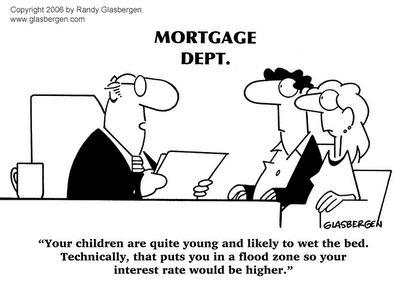
Today I’m going to talk about a couple myth’s and truth’s about mortgages that people commonly misunderstand.

  • If you’re buying your second home (or third, or forth, of seventeenth) you can still put 5% down. There is NO rule about having to put 20% down on your next home. The only rule regarding first time home buyers is that they are the only ones eligible to use their RRSP’s as a down payment without penalty.  You can even have two homes at the same time that you’ve put 5% down on. Say for example three years ago you bought a house with 5% down the you live in, and now you want to buy a cabin with 5% down. YOU CAN!
  • If you put 20% down you get a better rate. Sadly this is not usually true. Especially with the new rules some lenders have made it more costly for buyers that have 20% down. Not all lenders though! It will really depend on your situation as a whole, but be prepared to see slightly higher rates if you have a higher down payment. (I know, it makes little sense, but its the reality of the new mortgage market).
  • If your mortgage is up for renewal, you don’t have to requalify. Provided your lender has offered you a good rate and you want to stay with them, you can just sign on the dotted line and stay right where you are! This can make things a lot less stressful if the last couple years in oil town were hard on your finances. Be sure to have your broker review your renewal offer to make sure staying is what you should be doing!
  • Alternatively, if another lender has a better offer for you (and you qualify to move) you can and its usually free! Again, make sure you talk to your broker to review all your options!
  • If you’re buying a rental, be prepared to put 20% down and pay higher rates. Gone are the days of insured rentals and competitive rental rates.
  • If you’re refinancing be prepared to pay higher rates as well. Unfortunately the government has made it harder and more expensive to access your own equity.
  • You can still buy a home with a borrowed down payment. This one is a little more tricky, but if you have good credit and the ability to debt service the payback of your borrowed down payment you can use a line of credit or other credit avenues for your down payment. I don’t always advise it, but it can work in the right situations!

Overall with all the new rules and changes the mortgage world is even more complicated then before. We’re always here to help you navigate these complicated rules.

Is it the right time to refinance?

27583393_10159862612885510_287507074_n

Is it the right time to refinance? Countless Canadian news outlets have recently reported that the ratio of Canadian household debt to disposable income has hit a new record high. As rates are steadily increasing now might be the perfect time to refinance your current mortgage. As interest rates continue to rise, so will housing prices, so you may have more equity in your home than you think you do. Having more equity in your home opens up new opportunities to consolidate your high-interest debt. Using the equity in your home can help you solve your personal debt situation while letting you keep your home. Rolling your existing debt into one payment knocks out those high rate credit card payments into low single rate interest rates, which can give you a clean start.

Not only can refinancing lower your current payments and help you pay off your existing debt more quickly, it can save your credit score. Of course, we need to do the math on your current mortgage penalty. If you are locked into a fixed rate, you’ll have to pay a penalty to escape your existing deal with your bank. If you have a variable rate mortgage, the formula is simple: it will cost you three months interest on the existing mortgage. If you are locked into a fixed rate the penalty will most likely be interest rate differential, which can be scary in some instances, but we will be there to help you make the right decision.

Every situation is different. We want to help you save money, not spend money, so we’ll review your unique situation. Today might be a great day to refinance. It’s worth doing your research to see what your options are and then act swiftly before interest rates rise. Call us today to see what we can do for you!

Bank Mortgage Specialists vs. Mortgage Brokers

This blog post will be a little different, as we’re just going to be sharing a VERY well written article by Bud Jorgenson, VP.TMG  Prairies, Mentor of the Year, 2017, Mortgage Professionals Canada (MPC)

What’s best for consumers?

We need to clear the air. We’ve recently come across marketing materials that some Bank mortgage specialists have been sending aimed at “educating” members of the public on the impact of the mortgage rule changes and the limitations of dealing with mortgage brokers. Some bank specialists are referring to mortgage brokers as sub-prime brokers and that the recent changes to the mortgage rules will negatively impact us. As mortgage brokers we would like to respond.

We agree that it is vital for Canadians to be educated on the ways in which the most recent mortgage rule changes coming into effect, and all recent regulatory and legislative changes will impact mortgage consumers and markets as a whole. We applaud all efforts to bring awareness at this very important juncture in our industry.

The Office of the Superintendent of Financial Institutions (OSFI) is an independent government agency whose mandate is to supervise federally regulated financial institutions. OSFI is the agency who is updating their B-20 underwriting guidelines that came into effect on January 1, 2018.

In addition to having access (directly or indirectly) to most of the major Tier 1 banks in Canada, mortgage brokers also have access to many other provincially-regulated and private mortgage lenders. Those lenders include Credit Unions, Monoline mortgage lenders who have funded hundreds of billions of dollars in aggregate (including First National, MCAP, Merix, Street Capital, etc) alternative lenders (Canadian Western Bank, Equitable Bank, Home Trust, etc.) and private lenders. This allows brokers to ensure that the features of the mortgage are aligned to the client’s needs. Brokers will look at prepayments options, how penalties are calculated, how the mortgage is registered and how the client credit fits against the available products.

Perhaps it is only semantics but when a customer deals with a broker they do not have to ‘negotiate’ a rate with the lender directly – the broker shops the market to secure the best overall cost of borrowing for the unique needs of the consumer. This competition maximizes the opportunity for a consumer to get the best overall deal.

The recent OSFI changes are actually targeting all consumers (including the federally regulated banks) rather than only the subprime market. In fact, it may create market share opportunities for subprime lenders.

We certainly agree on the need for consumers to get the best advice. A mortgage broker is licensed with their corresponding provincial regulator. They have to meet initial education and licensing requirements and then have to maintain educational requirements going forward. Given the breadth of lender and mortgage products available to brokers, they have to constantly do research on the options available to their clients.

Brokers also get to deal with large regulated banks. Sometimes that represents the best option for the client to consider. Other times specialty lenders, mono-line lenders and unregulated lenders represent the best interests of consumers. Broker market share has actually increased steadily since the onset of the Global Financial Crisis and with each additional mortgage rule and regulation changes. This is because brokers are best suited to assess a mortgage client’s needs and then access a number of market options to fit those needs.

Debunking the myths

Myth: With the broker channel, the goal is to move the mortgage on each renewal

Reality: The goal of the broker channel, in general, is to present multiple options to consumers so they get the optimal mortgage for their unique needs. That includes looking at prepayment options, type of mortgage charges, costs of borrowing, portability, etc. Brokers often advise their clients to stay with their current lender at renewal.

The goal at renewal is exactly the same. The result of providing clients with the best ongoing advice at the time of origination and at renewal, a broker is able to grow their referral networks.

Myth: If the client remains with the same lender at renewal a small trailer fee is paid to the broker.

Reality: This is true in some cases and creates accountability between the lender, broker and customer in those cases.

Myth: If they (brokers) move the mortgage to a new lender then the full mortgage commission is paid as it represents a new deal to that new lender. This becomes a “residual or passive income” source for the broker

Reality: If a client chooses to move their mortgage at renewal after being given the options then it is considered a new deal. As such it has all the corresponding work associated with any new file at that time. That is not residual income – it is earned income and in most cases paid by the financial institution receiving the mortgage, NOT the client.

Clients save money when they work with a mortgage broker at renewal

The Bank of Canada released a report a few years ago titled “Competition in the Mortgage Market” and found the following:

Banks also offer larger discounts to new clients than to existing clients. Consumers willing to switch financial institutions when shopping for their mortgage will see, on average, an additional discount of 7 basis points from the posted rate. The results also indicate that borrowers who use a mortgage broker pay less, on average, than borrowers who negotiate with lenders directly. This average discount is about an additional 19 basis points.”

Most mortgage brokers offer ongoing advice and information to their clients. Because they deal with a wide variety of lenders for unique circumstances they are often very well versed in issues affecting mortgage borrowers.

For example, as of January 1st, a bank rep may tell you all uninsured mortgages have to be qualified at the benchmark rate or 200 basis points (whichever is higher). What they mean to say is all their mortgages are qualified in that manner.

It may be that a bank may be the best option for many clients but other lenders, credit unions for example, can still qualify the borrower at the contract rate.

By working with a licensed mortgage professional, you have a trusted advisor and problem solver, who is best positioned to navigate these changes.

Brokers take the time to first understand a client’s needs, both short term and long term, then recommend the right mortgage and present options. As the lending environment changes, brokers keep up-to-date with all these changes and have access to a variety of lenders including banks, credit unions, trust companies, monoline lenders and private lenders. No one is more knowledgeable and more informed than we are.

Tired of renting, but struggling to save the minimum 5% for the down payment of a new home?

69406526fd85c8bb10a4a4c8d809145d

Tired of renting, but struggling to save the minimum 5% for the down payment of a new home?

Saving for a down payment is one of the biggest obstacles between first-time buyers and home ownership. Luckily, purchasing a home with 0% down is possible. Of course, we still need to confirm you have a good credit history and a credit score high enough to qualify for the program. Our flexible down payment works with lenders that allow you borrow your down payment. Your borrowed down payment can come from a line or credit or a personal loan. Your line of credit or loan repayment will be factored into your debt ratio before approval- you must be able to afford to pay it back in addition to your mortgage payments.

There has got to be a catch right? The high ratio insurance fees are slightly higher than if you used your own funds for the minimum 5% down payment. These costs can easily be offset by getting into a property a few years earlier than if you were to save the money while renting. Keep in mind, there will still be regular closing costs such as legal fees, moving costs, and different charges for setting up utilities and everything else you’ll need in your new place, so its still important to have some savings!

If you need help improving your credit score to qualify for one of these programs, we are happy to do a consultation with you to help you get started on the right path to being approved. Call us today for more information! Raelene 306.830.4144 or Jill 780.872.2914

Creditor Mortgage Insurance

a54f62b84f1c27b2a9710497c621ed09

What the banks don’t want you to know about creditor mortgage insurance:

1) Creditor insurance programs do not contractually guarantee rates. The insurer may increase their rates or even cancel the policy with only 30 days notice, leaving you unprotected.

2) The amount of coverage you have decreases every time you make a mortgage payment meaning you pay the same premiums month to month but the amount you are covered for continuously decreases.

3) Coverage terminates when your mortgage is paid in full but you may still need coverage. You’ll be older and the insurance premiums will likely cost you more if you are still insurable.

4) Creditor mortgage coverage does not give you the option of taking the death benefit in a lump sum payment and continuing to pay the mortgage, which may be advantageous in a rate-increasing environment.

5) The underwriting for creditor insurance happens at the time of claim…. YES, AFTER IT’S TOO LATE! The big banks will tell you that creditor insurance is a good option to people who have been declined for other types of insurance but the truth is, they will almost always take your premiums but you won’t know if you are really covered until after its too late.

Insurance can be a confusing topic but it’s very worth your while to understand what you are getting into. CBC Market Place has ran an interesting investigation into Creditor Mortgage insurance here https://www.youtube.com/watch?v=MvtcfTrPJJE and here https://www.youtube.com/watch?v=CanwSISE1wk.

Insurance is a safety net for when the unexpected happens. Life insurance offers a way for your family to continue living comfortably and without worry in a difficult time. Call us today and we can help you get a protection plan in place!

STOP! Don’t Sign That Mortgage Renewal!

STOP-423x260

So the time has come to renew your mortgage. Did you know you don’t have to stay with your current lender? Just like you shopped for the perfect mortgage when you bought your house, shopping for the perfect mortgage when your term is up is just as important!

Approximately 120 days before your mortgage is due for renewal you should start looking at your options. Most lenders will hold rates for that long, so you can get everything in line with plenty of time to secure your new rate. Some banks will call you around the 4 month mark to offer you an early renewal rate, and some will wait until just four weeks before your term is up with an offer, this leaves hardly enough time to explore your options. They know this and hope you’ll just sign back one of their offers.

Here is where it gets interesting. More often then not the rates offered on a renewal are not even remotely competitive, I’ve seen offers of 4.79% on a five year fixed on a renewal when everyone else is is offering 2.79%.  That’s a full 2% higher, they’re hoping you don’t notice. If you have a $500,000 mortgage, that’s a difference of $47,600 over five years!

Please do not automatically sign the friendly mortgage renewal form. At a minimum call a mortgage broker to get the best deal for you. Most mortgage brokers will do a free review of your offer to see if you’re getting the best deal and rest assured, if we do one for you and its best for you to stay with our current lender, we will tell you that 100% of the time. It will cost you nothing  and it could save you thousands!  Call a mortgage  broker your future net worth will be glad that you did.